
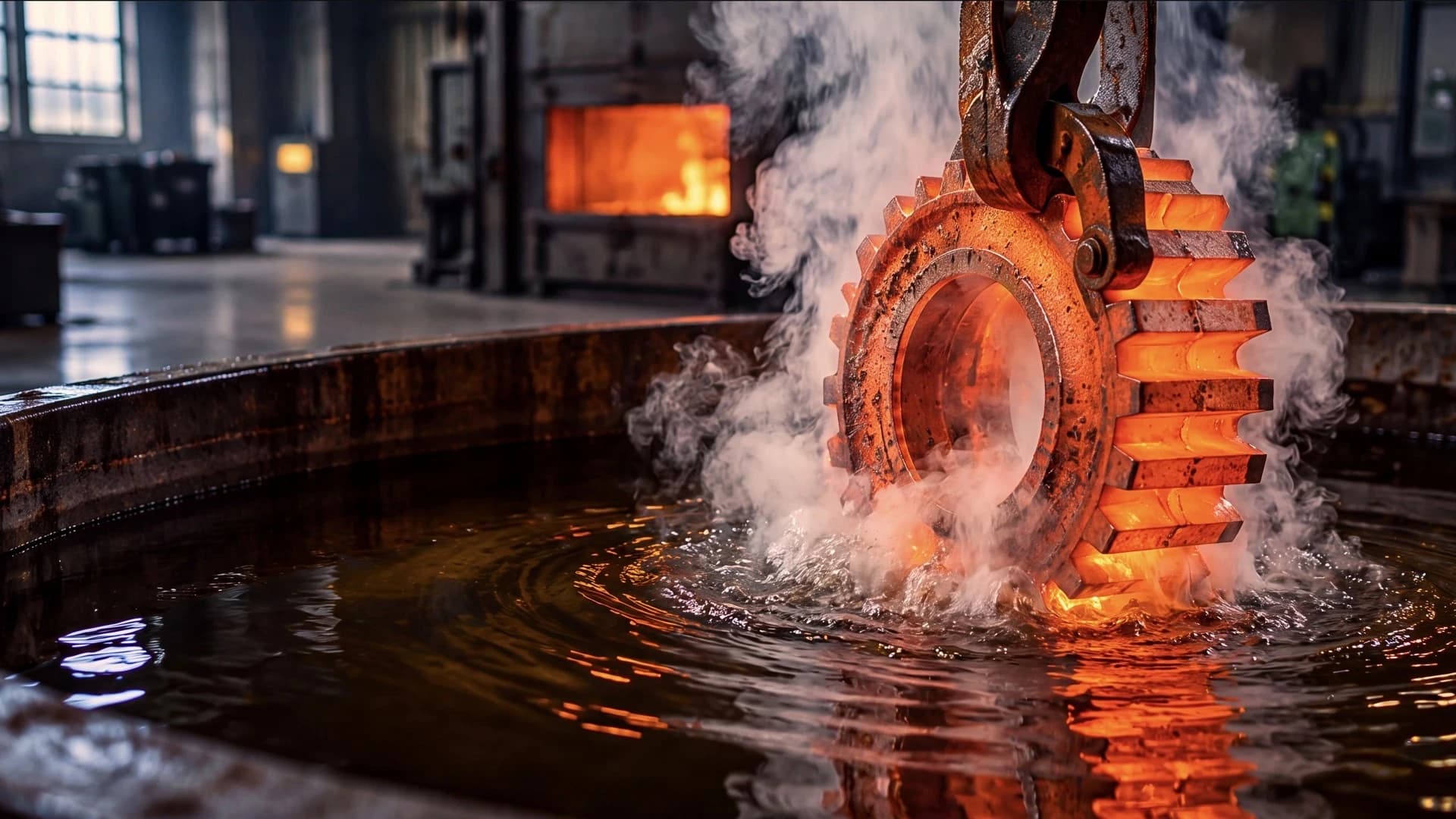
A quench crack opens in a steel part during the fast cooling that hardens it, or hours afterward, when the stress that the cooling itself builds inside the part exceeds what the steel can take. There is almost always more than one cause: steel, part, furnace and bath. If nobody changed the steel specification, the part or the furnace, the suspects are the oil bath and the steel lot, and a laboratory test shows whether the oil has changed.
What is a quench crack?
It is a crack that starts during the quench itself, or soon after it, before the part gets the treatment that makes it less brittle.
You know the scene: the part leaves the furnace glowing and hisses as it enters the tank. That is quenching: heating the steel until it glows and cooling it fast so that it hardens. That fast cooling produces martensite, the hard structure the quench is after, and also a brittle one, more so the more carbon the steel has (see how quenching hardens steel).
That is why the quench is followed by tempering, a gentle reheating that relieves the internal stress and the brittleness: the part trades a little hardness for resistance to breaking. A quench crack is born in the bath or in the wait before tempering: right away, minutes later or hours later.
It is usually thin, straight or barely branched, and deep, and it starts at a corner, a hole, a slot or a change of thickness. Often you cannot see it with the naked eye. It shows up in three ways:
in magnetic particle testing (the part is magnetized and iron powder gathers at the edge of the crack, making it visible);
in grinding, the finishing step in which a grinding wheel, a spinning stone, removes material from the part;
or when the part is already assembled.
How it shows up in your plant: the part passes the hardness test and cracks at the grinder or in inspection; or a whole lot comes out cracked at the same spot on the part.
For those who need the number: across industry, magnetic particle testing follows ASTM E3024/E3024M.
But if nobody hit the part, where does the stress that opens it come from?
How does a quench crack form?
It forms because the surface and the center of the part harden at different moments, and steel swells a little as it hardens.
Think of a glass bottle full of water forgotten in the freezer: the water turns to ice, swells and cracks the glass, which is already rigid. In the part, the glass is the skin, the surface, and the water is the core, the center, which cools later. The difference is that, in steel, the skin swells too, only earlier. When the core's turn comes, the skin is already hard and does not follow, like the glass.
Two facts explain the rest. Martensite starts to form at a temperature that belongs to each steel, the Ms (martensite start). And martensite takes up a little more space than the steel it came from.
The skin reaches Ms first and becomes martensite, hard, while the core, still hot and soft, gives way to its swelling.
Seconds later the core also reaches Ms and swells, so the core pushes from the inside a skin that no longer gives.
This internal force is called stress. In the skin it pulls the material sideways, like someone stretching a rubber band: that is tension, the stress that opens cracks (the opposite, compression, squeezes the material and protects it).
If the tension exceeds what the martensite can take, the skin opens, almost always from a sharp corner (an edge with no rounding) or from a surface defect.
Figure 1. The skin becomes martensite first while the core gives way; when the core becomes martensite and swells, it pulls the hard skin, and the crack opens at the sharp corner.
The skin reaches Ms first because it is cooler than the core. From that comes the rule of this article: the greater the temperature difference between skin and core while the martensite forms, the greater the stress.
For those who need the number: Ms generally falls between about 200 and 400 °C in oil-quenched steels and drops with more carbon and more alloy; in low-carbon steels, which rarely crack, it sits above that range (Andrews, 1965). Martensite takes up a few percent more volume than the red-hot steel, more as carbon rises.
If everything depends on that skin-to-core difference, what makes it grow?
What causes quench cracks?
Everything that raises the stress or weakens the skin. The causes come from four sources that almost always act together: the steel, the part, the furnace with the machining, and the bath.
The steel. Here hardenability comes in, how easily the steel hardens all the way to the core. More carbon makes martensite harder and more brittle. More alloy (the other metals mixed into the steel, such as chromium, molybdenum and nickel) makes the core turn to martensite and swell too, and that late swelling is what pulls the skin. Alloy also lowers Ms.
So steel with high carbon and alloy is the most sensitive. And steel varies a little from one lot (the heat, each batch of steel made at the mill) to the next, within the specification, without anyone deciding it.
The part. A sheet of paper tears easily from a small nick at the edge, not from the middle. In the part, that nick is the stress raiser: sharp corner, hole near the edge, keyway (the slot cut in a shaft for the key that locks a pulley), thread, abrupt change of thickness.
Stress builds up there, and the thin section cools before the thick one next to it. The thickness of the part is called its section, and a part with a thick section beside a thin one is the one that suffers most.
Figure 2. The crack starts at stress raisers; with a rounded corner, the stress spreads out.
The furnace and the machining. Heating above the temperature or for longer than the steel calls for makes the grain grow (the tiny crystals that steel is made of), and coarse grain makes steel more brittle. Decarburization, the loss of carbon from the surface to the furnace atmosphere, leaves a softer, weaker skin than the layer beneath.
And a deep machining mark, a tool scratch or a number stamped with a punch (an identification mark struck into the part) acts like the nick in the paper. That is why the finish counts, and with it the tool, the feed (how far the tool advances per turn of the part) and the cutting fluid for machining.
The bath and the way of dipping. What weighs in is a bath too severe for that steel (severity is how strongly the bath pulls heat out, covered in the next section), uneven agitation, the wrong temperature, water in the oil and aged oil.
Dipping and fixturing weigh in too: a long part that goes in sideways, or a basket that covers a hole or hides a face, cools one side before the other.
Of the four sources, the bath is the one that changes with use itself, every day, with nobody touching the process.
For those who need the number: the heating temperature before the bath generally falls between about 780 and 900 °C in carbon and low-alloy steels, depending on the steel (ASM Handbook, vol. 4D).
Because it changes by itself, the bath deserves a closer look.
How does the oil influence quench cracking?
The oil decides how fast the part cools at each moment, and what weighs most in cracking is the speed in the final stage, when the martensite forms.
Oil is one of the quenching media, the liquid that takes heat out of the part, and the strength with which it takes heat out is called severity. With the bath still, from most to least severe: brine, water, polymer in water (water with a dissolved additive; the more additive, the milder, and it can sit between water and oil) and oil. The comparison is in the article on quenching in oil or water.
In the bath, the oil cools the part in three stages:
Vapor blanket: the oil touching the steel turns to vapor and forms an insulating blanket; cooling is slow.
Boiling: the blanket breaks, the oil touches the part and boils. It is the fastest stage and the one that decides hardness: in it the steel passes quickly through the range in which it would become soft steel and reaches Ms ready to become martensite.
Convection: heat leaves only through the oil circulating around the part; cooling becomes slow again.
In oil, convection coincides in good part with the Ms range, and the speed there is what weighs most in cracking. By the rule seen in how the crack forms, it is in this stage that the skin-to-core difference becomes stress. That is why the ideal oil is fast in the hot part, to harden, and mild in the final stage, to avoid cracking. This shows in the cooling curve, the record of the temperature of a test piece in the bath over time.
Figure 3. Both curves cool the same in boiling, the stage that decides hardness; the one that falls slowly in the Ms range builds less stress. Illustrative drawing, not to scale.
Four bath factors shift this balance:
Type of medium: water and brine cool much faster than oil in the final stage; steel made for oil, quenched in water, has a high risk of cracking.
Bath temperature: in oil, a warmer bath brings the part and the bath closer in temperature in the final stage. The part cools more slowly there, skin and core become more alike and the stress drops (the principle of marquenching). In water the effect that matters is another: warm water lengthens the vapor stage and gives a soft spot, a region left without the hardness required.
Agitation: it speeds up cooling, especially when breaking the vapor and in the final stage; uneven, it cools one side before the other, which leads to cracking and to distortion (the part bends).
Condition of the oil: oxidation (the oil reacts with oxygen in the air, faster when hot), sludge (residue that settles at the bottom of the tank) and contamination change the curve. Oxidized oil tends to get faster, and the part cracks more; accelerated oil that has lost additive gets slower and leaves soft spots. The oil that quenched well when bought may quench differently months later.
For those who need the number: each quenching oil boils in a range that generally falls between about 230 and 480 °C, depending on the formulation. When the surface of the part drops below the range of its oil, boiling stops and convection begins; that is why a good part of the Ms range falls in convection.
Among the readings of ASTM D6200 is the cooling rate at 300 °C, used for crack risk because 300 °C lies within the Ms range of most oil-quenched steels.
Among the oil contaminants, one deserves its own question.
Does water in quenching oil cause cracks?
Yes, and it is one of the most common causes of a crack that appears suddenly in a process that had been stable.
Water acts in two stages:
It makes the vapor blanket longer, which leads to soft spots.
Then the water keeps boiling down to lower temperatures, inside the Ms range, which leads to abrupt cooling just when the skin becomes martensite, and so to cracking and distortion.
Water does not always spread evenly: droplets and water at the bottom of the tank can make the effect uneven on the same part.
The most common sources are:
a leak in the water-cooled heat exchanger (the device that removes heat from the oil with water circulating in tubes);
condensation in an idle tank;
a part that arrives wet from washing.
How it shows up in your plant: a different crackle or hiss when the part is dipped, foam in the tank, hardness varying within the same part, and cracks in lots that used to pass.
For those who need the number: the ASTM D6710 guide sets no water limit; the usual reference is to stay below 0.1% (1,000 ppm, parts per million). In steel of low hardenability, even below 0.05% (500 ppm), water can already cause a soft spot.
And when the part leaves the bath in one piece, is the risk over?
Why does a part crack hours after quenching?
Because the stress stays inside the part after the bath, and freshly formed martensite, without tempering, is steel at its most brittle.
It is like a stretched rope that snaps on its own, with nobody pulling any more, at a spot that was already worn. It happens for two reasons:
The stress born in the bath stays stored in the part, and a corner or a defect can give way with time.
Part of the steel may not have turned to martensite in the bath and transform later, already on the bench, with new swelling.
This is the delayed crack. That is why tempering comes right away: as soon as the part is warm to the touch, without letting it cool completely and without waiting for the next furnace load or the end of the shift.
It does not help to temper with the part still too hot either: steel that has not yet transformed becomes martensite after tempering, brittle and with no relief. The right point, then, is warm to the touch.
Figure 4. The stress from the bath stays stored on the bench; tempering with the part warm makes it drop before the crack opens.
Another crack is born in this same interval. Straightening, that is, correcting a part that distorted in the bath, before tempering forces the still-brittle martensite and cracks the part. Straightening comes after tempering.
For those who need the number: for 4340 steel (an alloy steel widely used in shafts, by SAE numbering), heat treatment guides call for tempering, in general, within 15 minutes after the bath (Heat Treat Today).
You found a crack: how can you tell whether it really started in the quench?
How do you tell a quench crack from a grinding crack?
By the pattern of the crack and the color of its faces. The difference matters because the fix is different: a grinding crack is solved at the wheel and in the grinder's coolant; a quench crack, in the steel, the part, the furnace and the bath.
Grinding also cracks the part, because it heats and cools the already hard skin in an instant. When the surface gets too hot from friction with the wheel, it changes color and hardness: that is grinding burn.
| Origin | What it usually looks like | Where it is fixed |
|---|---|---|
| Quenching | Deep, straight or barely branched; starts at a stress raiser | In the steel, the part, the furnace and the bath |
| Grinding | Shallow, in a fine network or across the direction of the wheel marks; often with burn | At the wheel and in the grinder's coolant |
| Earlier defect, from forging (hot shaping of the part) or from the material itself | Was already in the part before the quench; the quench only opened it | In forging, in rolling (the mill that shapes steel into bars and plates) or in buying the material |
Two signs help tell them apart:
The color of the crack faces, when the part is broken open for inspection. Darkened faces indicate a crack that already existed at tempering, because heat oxidizes the open faces: it was born in the quench or before. A clean, bright face indicates a crack opened later, in grinding or in service. The sign only holds when tempering is done in air: in a vacuum furnace or with a protective atmosphere, the face comes out clean even with an old crack.
The microscope: a forging crack usually has thick oxide on its walls and steel around it without carbon, because it opened at high temperature; a quench crack has at most the thin oxide film of tempering, with no carbon loss around it.
Figure 5. The pattern of the crack tells its origin: deep and leaving the corner in quenching, shallow and in a network in grinding, with oxide and decarburized steel around the crack in the earlier defect.
The final confirmation is metallographic analysis (the part cut, ground, polished and viewed under the microscope), done by a metallurgical laboratory.
For those who need the number: grinding burn is confirmed by chemical etching of the surface (ISO 14104), more sensitive than the hardness test.
If the crack was born in the quench and the process did not change, what remains is to confirm whether it was the bath.
How does Kelpen Oil check quenching oil?
By comparing the cooling curve of a sample from the tank with that of the same oil when new, or from the time the process was approved. The curve tells whether the oil changed; the other tests tell why.
The Kelpen Oil in-house laboratory in Arujá (SP) measures the oil's curve by ASTM D6200 and the polymer-in-water curve by ASTM D6482, on the IVF Smart Quench equipment. For other companies it is a paid service, including oil from another manufacturer.
| What we measure | What it reveals | Standard |
|---|---|---|
| Cooling curve of the oil | The speed in the final stage, where the crack is born | ASTM D6200 |
| Cooling curve of polymer in water, with agitation | The same reading, for the polymer | ASTM D6482 |
| Water in oil, by the Karl Fischer method (a chemical reaction that counts the water) | How much water got into the bath, in ppm | Karl Fischer method |
| Total acid number (TAN) | How much acid oxidation has already formed | NBR 14448 |
| Kinematic viscosity at 40 °C (the oil's resistance to flowing) | Oil that thickened from oxidation or thinned from mixing | ASTM D7042 |
| Infrared spectrum (the infrared light the oil absorbs, which shows what is in it) | Oxidation products and contaminants | ASTM E2412 |
| Flash point (the lowest temperature at which the oil's vapor flashes over a flame) | The safety margin against fire; a drop indicates contamination | NBR 11341 |
Keep the curve of the new oil as a ruler: without it, the sample from the tank has nothing to be compared with.
With the cause found, what remains is what to do so the next load comes out whole.
How do you prevent quench cracking?
By reducing the temperature difference between skin and core (the rule seen in how the crack forms), removing from the part the spots where cracks start, and tempering right away.
| If in your plant... | What to do | Why |
|---|---|---|
| The part has a sharp corner, slot, hole near the edge or abrupt change of thickness | Round the corners and move the hole away from the edge in the design; otherwise, a milder bath and uniform agitation | The stress raiser accumulates stress |
| The part is long or has a cavity | Dip it vertically, along the longest axis, without covering a hole or face in the basket | Vapor stays trapped in the hole or cavity, and the face underneath it cools later than the rest, like the face covered by the basket |
| The steel already hardens in conventional oil (high hardenability) | Conventional oil, not a faster one | Cooling faster than needed only raises the stress |
| The steel comes out soft in conventional oil (low hardenability) and cracks in water, or has a hole and comes out with a soft spot | Accelerated oil (with additives that break the vapor earlier) or polymer in water, with uniform agitation and tested first on a lot | They cool faster than conventional oil in the hot stage, without the abrupt final stage of water |
| The process requires a non-flammable medium | Polymer in water, with the concentration chosen by the curve | It does not catch fire; the speed changes with concentration, between that of water and that of oil |
| Cracking began without any change in steel, part or furnace | Analyze the oil in use (curve and water) and check the steel lot certificate | The bath and the steel lot change without anyone deciding it |
| After the bath, the part waits or is straightened before tempering | Temper as soon as it is warm to the touch and straighten only after tempering | Stored stress opens the delayed crack, and martensite without tempering cannot take the load |
| The part came out soft and will be quenched again | Relieve the part first (see the frequently asked question on re-quenching) | It already carries the stress of the first quench |
We at Kelpen Oil formulate quenching oils in two lines: the Micro Temp line, with options for steels that are hard to harden, and the Austenity line, with conventional and accelerated quenching options for ferrous metals (those based on iron, such as steel). We also formulate a non-flammable polymer-in-water quenching fluid. The Technical Team recommends the oil by steel, section and part shape.
Frequently asked questions
Does tempering close a quench crack? No. Tempering relieves stress and reduces the brittleness of martensite, so it prevents a crack that has not yet opened. One that has already opened stays in the part and sometimes even gets easier to see, with darkened faces.
Can a part with a quench crack be recovered? As a rule, no: the crack does not close with another heat treatment, and the cracked part becomes scrap. Only a shallow crack, in a region with machining allowance (extra material on the part, which machining removes), sometimes comes out in machining, with a new test, when the drawing allows. The work lies in finding the cause and avoiding the next one.
How do you find a quench crack that cannot be seen with the naked eye? By magnetic particle testing, which works on steel and other metals that a magnet attracts. It shows the crack at the surface and just below it. The depth is confirmed in the metallographic section.
Does re-quenching a part that came out soft raise the risk of cracking? It can, because the part already carries the stress of the first quench. The usual way is to relieve the part first, by annealing (reheating with slow cooling inside the furnace) or by normalizing (reheating with cooling in air), and only then quench again.
Glossary
Martensite: hard, brittle structure that forms in steel cooled fast in quenching.
Tempering: gentle reheating after quenching that relieves internal stress and brittleness.
Ms: temperature, specific to each steel, at which martensite starts to form.
Hardenability: how easily the steel hardens all the way to the core.
Stress raiser: sharp corner, hole, slot, thread or abrupt change of thickness, where stress accumulates.
Decarburization: loss of carbon from the steel surface to the furnace atmosphere, which leaves the skin softer and weaker.
Severity: how strongly the bath takes heat out of the part.
Soft spot: region of the part left without the hardness required.
Talk to the Technical Team
The Kelpen Oil Technical Team evaluates the steel, the shape of the part, the temperature and agitation of the bath and the crack history, and confirms the right product among the heat treatment oils. If the oil is already in use, the Arujá (SP) laboratory performs the analysis of the oil in use, with the cooling curve, as a paid service.
Before blaming the oil, note four things about the cracked part: the steel and the lot, the point where the crack starts, how long it waited until tempering and the color of the crack faces. With that data and a sample from the tank, the cause usually shows up. Send this article to whoever handles heat treatment at your company.


