
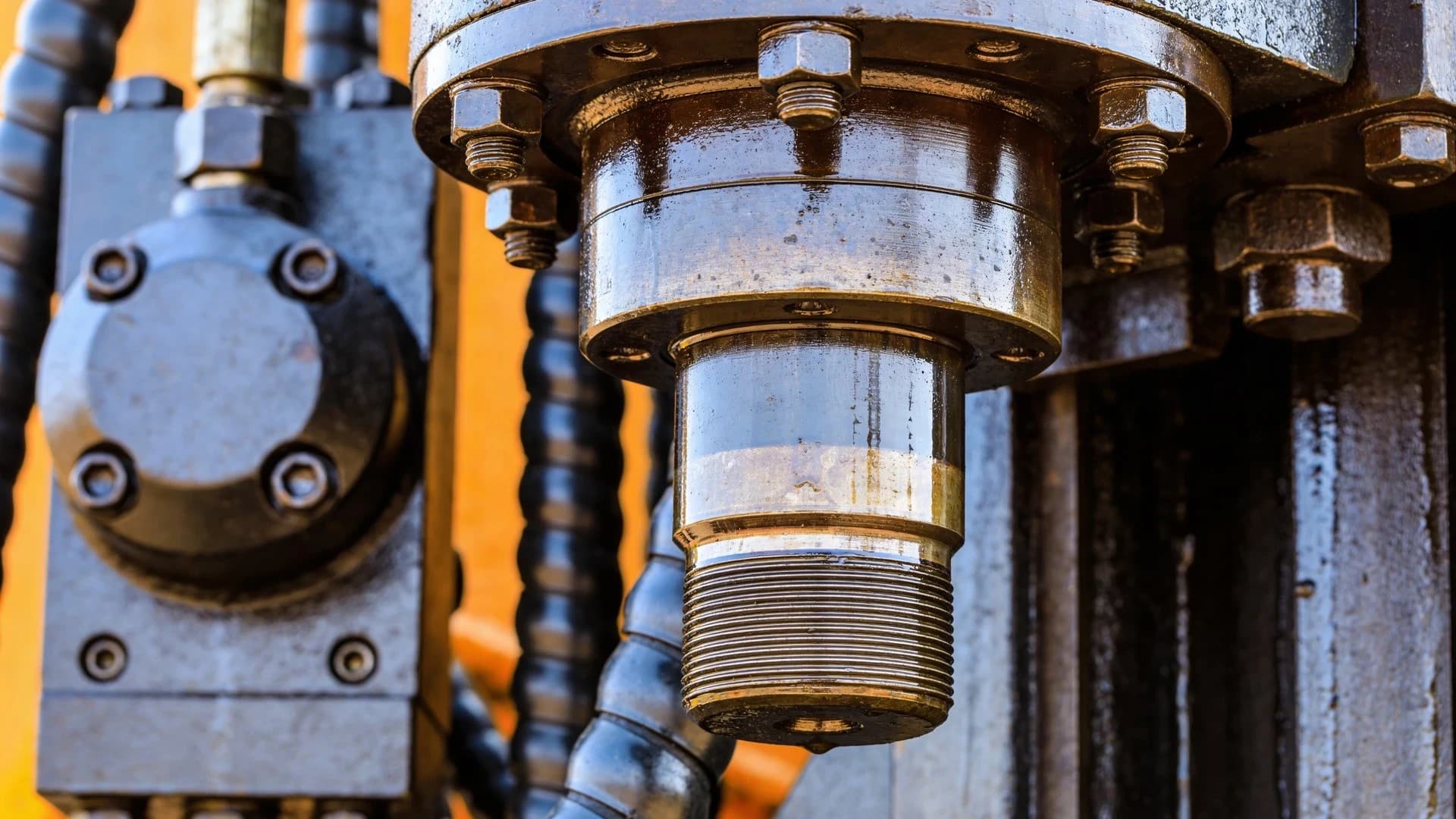
HLP oil is the most widely used hydraulic oil in industry: besides protecting the machine from rust and aging, it carries an ingredient that shields the pump from wear when it works under pressure. It is the oil recommended for the pump of presses, plastic injection molding machines and machines that cut and drill metal, such as lathes. The name comes from a German standard, and a maker should call an oil HLP only when it passes that standard's tests, among them the wear tests.
What is HLP oil used for?
HLP oil carries force inside the hydraulic machine and, along the way, protects the pump that pushes it.
Think of a garage hydraulic jack. You pump the handle, the oil is pushed under the piston and the car rises, because oil barely lets itself be squeezed.
In a factory machine, the pump pushes the oil, driven by an electric motor. The pushed oil moves the cylinder, the part that closes the press or the injection mold. To push hard, the pump works with the oil at high pressure.
Inside, the pump parts slide over one another with clearances far thinner than a hair. Between them there is only a thin layer of oil, the oil film, which keeps metal from touching metal.
That is why hydraulic oil has three jobs that matter here:
carrying the force from the pump to the cylinder;
keeping the oil film between the sliding parts;
lasting without rusting the machine or breaking down from heat.
The full circuit and the oil's other jobs are in the guide to types of hydraulic oils. HLP was made for when the pressure is high enough to threaten that film. The three letters of the name show what it carries for the purpose.
What does HLP mean in oil?
The H says it is hydraulic oil; the L and the P add protections: the L against rust and aging, the P against wear.
To understand the letters, it helps to know what a finished lubricating oil is made of. Almost all of the product is base oil, the foundation of the lubricant. The rest is additives, chemicals in small doses that give or strengthen a quality. It is like a medicine tablet: almost all of it is filler, and the effect comes from a small dose of the active ingredient.
So that everyone calls the same oil by the same name, there is the standard, a public document that lists the tests an oil must pass to use that name. Hydraulic oils get their names from the German standard DIN 51524, and the letters add up:
H: hydraulic oil.
L: additives against rust and against oxidation, the reaction of hot oil with oxygen in the air, which thickens the oil and forms sludge.
P: anti-wear additive, which protects the parts when the oil film is not enough and raises the load the oil can take.
On the factory floor, many people read the P as "pressure." The idea is close, because anti-wear protection exists for the pump working under pressure, but in the standard the P means protection against wear.
In DIN 51524, part 1 is HL and part 2 is HLP. There are also HVLP and HLPD, which come up later and are explained in the guide to types of hydraulic oils linked above.
Figure 1. Almost all HLP oil is base oil; the letters add protections: HL has H and L, and HLP adds the P, the anti-wear.
For those who need the standard: the system of letters comes from DIN 51502, which names lubricants. DIN 51524 sets the minimum requirements for HL, HLP and HVLP oils, typically made with petroleum base oil, from any of API 1509 Groups I, II and III, as long as the finished oil passes the tests. HLPD has no requirements part of its own in DIN 51524. In practice, HLPD is declared on part 2, without the requirement to separate water, which it deliberately retains.
That leaves the question of how an additive, in such a small dose, protects a steel part.
How does the HLP anti-wear additive protect the pump?
It forms a thin film on the steel at the points where the parts come to touch, and that film wears away in place of the metal, as a shoe sole wears in place of the foot.
To see where this happens, look at a pump common in presses and injection machines, the vane pump. In it, blades called vanes sit in slots of a rotor, the central part that turns inside a steel ring. Each vane can slide out of its slot and rubs against that ring.
The rotor's spin pushes each vane outward, against the ring. In many pumps, the oil pressure itself also helps push and, because of that, the higher the pressure, the more force in the contact.
Under a microscope, all steel has peaks and valleys, like very fine sandpaper. This roughness is called surface roughness. What happens inside the pump follows this order:
The more load on the cylinder, the more pressure in the pump, which leads to more force between vane and ring.
At start-up, at a pressure peak or with hot, thinner oil, the oil layer becomes thinner than the height of the peaks, which leads to peak-to-peak contact. This regime is called boundary lubrication, and in it protection depends mainly on the additive.
In the contact, the tip of each peak heats up a lot at a tiny spot. Without anti-wear, some of these peaks weld together for an instant and tear off, which leads to wear of the ring and vanes and to metal particles in the oil.
In HLP, the additive reacts with the heated, squeezed steel exactly at those spots and forms a thin film bonded to the metal. The film wears away in place of the steel and renews itself as long as there is additive in the oil. This is one of the ways the additive is used up in service; heat and water are others.
When the additive runs out, or when the machine receives an oil without it, the pump wears and the clearance grows. Through the larger clearance, part of the oil leaks back inside the pump instead of going to the cylinder, which leads to less flow (less oil pushed each minute) and more heat.
How this shows up in your plant:
cylinder slower when the oil heats up;
noisier pump;
tank hotter than before;
filter with shiny metal particles.
Figure 2. In the contact between vane and ring, the anti-wear additive in HLP forms a film on the peaks that touch; it wears away in place of the steel and renews itself.
For those who want the chemistry: the classic anti-wear additive in HLP is zinc dialkyldithiophosphate (ZDDP). The film it forms is a thin, glassy layer of zinc and iron phosphates, with sulfides next to the metal, created by the heat and pressure of the contact. There are zinc-free HLP oils, with a phosphorus-based anti-wear, sometimes with sulfur, with no metal in the molecule. This type is called "ashless": ash is the mineral residue, formed by the metals in the additives, that is left when the oil is burned in the ash test.
HL does not promise this film. What remains is how to prove that an HLP has it.
What is the difference between HL and HLP oil?
The difference is the anti-wear additive and the proof that it works. HLP meets the same basic requirements as HL (rust, oxidation, water separation, air release and no foaming) and also passes two wear tests that HL does not have to take. These tests are required in the most-used hydraulic oils (32, 46 and 68; the number is explained below).
Think of a driver's license: saying you can drive is one thing, passing the exam is another. HLP takes two exams.
FZG gear test. The acronym comes from the German institute that created the test. The oil lubricates a pair of test gears while the load rises through 12 stages. The damage looked for on the teeth is scuffing, the welding and tearing of metal that you saw on the pump peaks. In HLP, this damage cannot appear before stage 10.
Figure 3. In the FZG test, the load rises through 12 stages; HLP may not show damage on the teeth before stage 10.
Vane pump test. A real vane pump runs with the oil for 250 hours, under pressure. Afterward, the ring and vanes are weighed, and the weight lost shows how much metal the oil let wear away.
Figure 4. In the vane pump test, the ring and vanes are weighed before and after; the weight difference is the metal the oil let wear away.
Side by side, the two classes look like this:
| Characteristic | HL (DIN 51524 part 1) | HLP (DIN 51524 part 2) |
|---|---|---|
| Protection against rust and copper corrosion (the oil must not attack copper and bronze parts) | Yes | Yes |
| Oxidation resistance | Yes | Yes |
| Water and air separation, foam control | Yes | Yes |
| Not attacking the rubber seals of the circuit | Yes | Yes |
| Anti-wear additive | Not required | Required |
| FZG gear test | Not required | No damage before stage 10, in the versions where the standard asks for it |
| Vane pump test | Not required | Required, in the versions where the standard asks for it |
| Typical use | Circulation (the oil runs through several points of the machine with no pump under high load) and bearings (the supports where shafts turn), without heavy load | Hydraulic pumps under pressure |
An HL may even carry some anti-wear, but the HL label neither promises nor proves it. Whoever needs the protection buys the letter P.
For those who need the number: part 2 of DIN 51524 repeats the properties of part 1 and adds the wear tests. The FZG follows method A/8.3/90 of DIN ISO 14635-1, with a damage stage equal to or higher than 10 (damage at stage 10 itself is accepted); in the thinnest grades of part 2, the FZG is not required. The vane pump test follows ISO 20763 (250 hours of operation) and applies to ISO VG grades 32, 46 and 68 of HM and HV oils (the ISO names of HLP and HVLP, explained in the next section).
In the catalog, though, the HLP label does not always appear. Often what appears is "AW."
Are AW and HLP oil the same thing?
Almost always the two names refer to the same type of oil, but they say different things.
AW stands for anti-wear. It is the market name for any hydraulic oil with an anti-wear additive and describes what the oil carries. HLP is the name the standard gives, and says the oil passed the tests you have just seen.
Every HLP is anti-wear. An oil sold as "AW," for example "AW 68," is HLP only if the label or the data sheet states "meets DIN 51524 part 2." The data sheet is the supplier's document with the product's characteristics. When buying:
compare quotes by the written standard, not by the name;
ask for the data sheet of each oil quoted;
be wary of "AW" with no standard at all.
No outside body certifies HLP. "Meets DIN 51524 part 2" is a statement by the manufacturer. Whoever wants proof asks for the data sheet and, if needed, an oil analysis, covered further on.
The Supra AW line, which Kelpen Oil formulates, is an HLP made with petroleum base oil that meets DIN 51524 part 2.
For those who need the number: in the international classification ISO 6743-4, HL remains HL, HLP corresponds to HM and HVLP corresponds to HV. The requirements of these classes are in ISO 11158, with limits close to, but not identical to, those of DIN 51524. An AW may also declare the HM class of ISO 11158, with similar tests; what matters is having a written standard on the data sheet.
With the letter understood, what remains is the question that comes up most when buying: the manual asks for 68 oil, now what?
68 oil: HL or HLP?
It depends on the machine, because the number and the letters answer different questions: the 68 gives the thickness of the oil, and the letters give the protection.
The 68 is the ISO VG grade. It measures the thickness of the oil, which has a technical name: viscosity, how much the oil resists flowing, as honey resists more than water. The measurement is made at 40 °C. The same 68 exists in HL and in HLP: the thickness is the same, and the protection is what changes. The right grade comes from the machine manual (see what ISO VG means).
The right letter comes from the machine's work. A pump working under pressure calls for HLP. Circulation and bearings without heavy load, with the manual asking for HL, accept HL.
| If in your plant… | Use | Why |
|---|---|---|
| Press, injection machine or machine that cuts and drills metal, with a pump under pressure | HLP, such as the Supra AW line | The anti-wear protects the vanes and the ring |
| Circulation, bearings and general lubrication with no pump under high load, with the manual asking for HL | HL: Supra line (DIN 51524 part 1) | Needs protection against rust and oxidation; anti-wear is not required |
| Outdoor machine, with a cold start and a lot of heat on the same day | HVLP: Supra HP line (DIN 51524 part 3) | The thickness changes less with temperature |
| A little water gets in and the tank cannot be drained | HLPD: Supra AWD line | HLP releases water at the bottom of the tank, where it can be drained; with no way to drain, HLPD keeps it spread through the oil in fine droplets and carries the dirt to the filter |
When in doubt between the letters, the machine manual rules. All the options in the table are on the Kelpen Oil page for industrial hydraulic oils.
For those who need the number: under ISO 3448, the ISO VG grade is the kinematic viscosity at 40 °C, in cSt (centistokes), with a tolerance of plus or minus 10% around the midpoint. ISO VG 68 runs from 61.2 to 74.8 cSt.
Many machines, though, already have HL in the tank. The next question is whether you can switch.
Can you switch from HL to HLP oil?
In most machines, yes: HLP meets the same basic requirements as HL and adds the anti-wear.
The reverse does not hold. HL in a pump that calls for HLP removes the anti-wear film and speeds up wear of the vanes and the ring.
When switching from HL to HLP, three precautions:
Keep the same ISO VG grade as the manual: 46 stays 46, 68 stays 68.
Drain the system instead of topping up, so the new charge does not mix with the old oil.
Check whether the manual forbids additives with zinc. Some machines forbid them because they have silver-plated parts or bronze and brass parts that run hot: the zinc additive, breaking down in the heat, can attack those parts. In that case, use a zinc-free HLP that the manual accepts.
For those who need a zinc-free oil, the Supra AWD line, a zinc-free HLPD declared in DIN 51524 part 2 as HLPD, is an option. Because HLPD holds the little water in the oil instead of separating it, the Technical Team confirms first whether it suits the machine.
In some machines, the manual asks for HL for a reason of the system itself. One example is water: it breaks down zinc anti-wear. Then the choice among HL, zinc-free HLP and HLPD depends on how water enters and leaves the tank, and the switch is confirmed beforehand with the Technical Team.
Putting engine oil in the hydraulic system is another subject, explained in using 15W40 oil in the hydraulic system.
After the switch, or when in doubt about the oil already in the machine, the last question comes up: how do you know it is really HLP and still has additive?
How does Kelpen Oil check whether an oil is HLP?
By the mark the additive leaves in the oil: the classic anti-wear carries phosphorus and zinc, and these elements can be measured, always comparing the sample with new oil of the same product.
The new oil is the ruler, and the machine's sample is compared with it (the types of oil analysis are explained in another article).
In the Kelpen Oil in-house laboratory in Arujá (SP), the ICP, an instrument that measures chemical elements of the additives in the oil, reads phosphorus and zinc. The reading follows two rules:
In an HLP in use, phosphorus and zinc below the new oil of the same product indicate consumed additive or oil mixed with another, and call for investigation. This drop can show up late: the additive breaks down, but the fragments with phosphorus and zinc stay in the oil and keep being counted. That is why the reading is completed with infrared, a test that passes light through the sample and compares its chemical "signature" with that of the new oil.
Since zinc-free HLP exists, missing zinc alone does not fail the oil. In that case, the infrared shows whether the oil still resembles the original and whether the anti-wear still appears.
Figure 5. In the report, the sample's phosphorus and zinc are compared with those of the new oil; lower bars indicate consumed additive or mixed oil. In a zinc-free HLP, zinc does not appear.
Water matters too. It breaks down zinc anti-wear, and that is why the report measures how much water is in the oil.
The FZG and vane pump tests prove the formulation once, in a specialized laboratory. Routine analysis tracks whether the oil in the machine still resembles that HLP. At Kelpen Oil, which formulates the Supra line, no batch is released without laboratory approval.
| What we measure | What it reveals | Standard or method |
|---|---|---|
| Phosphorus and zinc by ICP | Presence and drop of the anti-wear additive | By the NBR 14786 method |
| Infrared spectrum | Whether the oil still resembles the new oil, whether the anti-wear still appears, and signs of oxidation | ASTM E2412 |
| Water content, by the Karl Fischer method | How much water is in the oil, even the water you cannot see, which also wears out the anti-wear additive | By the Karl Fischer method |
| Viscosity at 40 °C | Whether the oil is still in the right ISO VG grade | ASTM D7042 |
| Particle count | Oil cleanliness, expressed by the ISO 4406 code, and an early sign of wear | ISO 4406 |
Analysis of oil in use is a paid service and applies to oil from any maker. Foam, water separation, acidity, copper corrosion and the other tests, and how each is done, are in the article on the Kelpen Oil lubricant laboratory.
Frequently asked questions
What do the numbers in HLP 32, 46 and 68 mean? They are the ISO VG grade, the thickness of the oil at 40 °C: the higher the number, the thicker. Under ISO 3448, 32 falls between 28.8 and 35.2 cSt (centistokes, the unit of viscosity), 46 between 41.4 and 50.6 cSt and 68 between 61.2 and 74.8 cSt. DIN 51524 part 2 runs from ISO VG 10 to 150; 32, 46 and 68 are the most used. The choice among them follows the working temperature and the manual, as shown in the difference between 46 and 68 hydraulic oil.
Can you mix HL and HLP oil? The two are usually compatible, but mixing dilutes the anti-wear, and the result is no longer a guaranteed HLP. In a pump that calls for HLP, always top up with HLP of the same grade. Oils from different brands only with the supplier's confirmation, because the additives can react with each other and form deposits.
What is HLPD oil? It is an HLP with detergent additives that gives up separating water: it carries loose dirt to the filter and keeps the little water spread through the oil in fine droplets, instead of letting it pool at the bottom. It suits places where a little water gets in and the tank cannot be drained; its limits are in the guide to types of hydraulic oils.
What is the difference between HLP and HVLP? HVLP is an HLP whose thickness changes less between cold and hot oil (DIN 51524 part 3). It is justified in machines with a cold start and a lot of heat in the cycle, such as those working outdoors.
Glossary
Oil film: thin layer of oil between two sliding parts, which keeps metal from touching metal.
Anti-wear additive (AW): additive that reacts with heated, squeezed metal at the contact points and forms a film that wears away in place of the part; in boundary lubrication, protection depends mainly on it.
Boundary lubrication: regime in which the oil layer is thinner than the roughness and the peaks of the two surfaces touch.
FZG test: test in which the oil lubricates test gears under rising load, in 12 stages; HLP may not show damage before stage 10.
ISO VG: viscosity grade of the oil, the thickness measured at 40 °C (ISO 3448).
Oxidation: reaction of hot oil with oxygen in the air, which thickens the oil and forms sludge.
Talk to the Technical Team
The Kelpen Oil Technical Team assesses the pump type, the pressure, the tank temperature and what the manual asks for, and confirms the oil letter and grade. If the oil is already in use, the Arujá (SP) laboratory performs the analysis of oil in use, as a paid service.
Before buying the next drum, look at three things: the letter and number the manual asks for, the standard written on the data sheet of the oil quoted, and whether the manual forbids additives with zinc. Send this article to whoever looks after the machines in your company.


